Award-Winning Research Reveals How Wildflowers May Struggle Under Climate Change
July 20, 2026
In Ohio, we think of fall as the end of the growing season. But for many California wildflowers, fall is a beginning. From the deserts of Southern California to the rocky outcrops farther north, seeds wait each autumn for the rains to come that will break the summer drought. When the rains arrive, the wildflowers sprout, preparing to flower and set seed in spring before the droughts come again.
But without these fall rains, these winter annuals don’t get the trigger they need to start their winter life cycle. And unfortunately, these fall rains are becoming increasingly sporadic due to climate change.
New award-winning research from Holden Forests & Gardens ecologist Samantha Worthy sheds light on what these changes might mean for these flowers. For her work, Worthy received the 2026 ASN Presidential Award, presented by the American Society of Naturalists for the best research paper in their scientific journal The American Naturalist each year.
This research lays the foundation for not only continued work in this special California ecosystem, but also new projects underway at the Holden Arboretum and Seed Bank. These new projects aim to help us understand how seeds of our regional species, whether sown by nature or by human hands, will be impacted as climate change disrupts their germination triggers.
It’s a fitting addition to the research program at Holden, where experts are already studying many of the unseen but critical parts of natural systems, like fungi in the soil and other microbes living alongside plants. Worthy sees seeds the same way. “Seeds are very much in that same lane, and we don’t know that much about them,” she says. “I hope as we share this new work, people will begin to appreciate their beauty and all they’re capable of.”
Waiting for Rain
The American Naturalist project was a part of Worthy’s postdoctoral research with distinguished biologist Johanna Schmitt at the University of California Davis. It builds on work in which Worthy simulated later and later rainfall, coinciding with cooler and cooler temperatures, to see how it would impact the number of seeds of various wildflowers that would germinate.
She found that even among closely-related species, some were much more particular than others. Some species, especially those that can be found in desert environments, which are used to unpredictable rains, were able to hedge their bets. These sent up a few seedlings almost any time water arrived, regardless of temperature or timing. But other species were much more finicky. If water arrived at the expected time, they germinated en masse. But if rains came too late, they didn’t sprout at all — it was too cold, or too late.
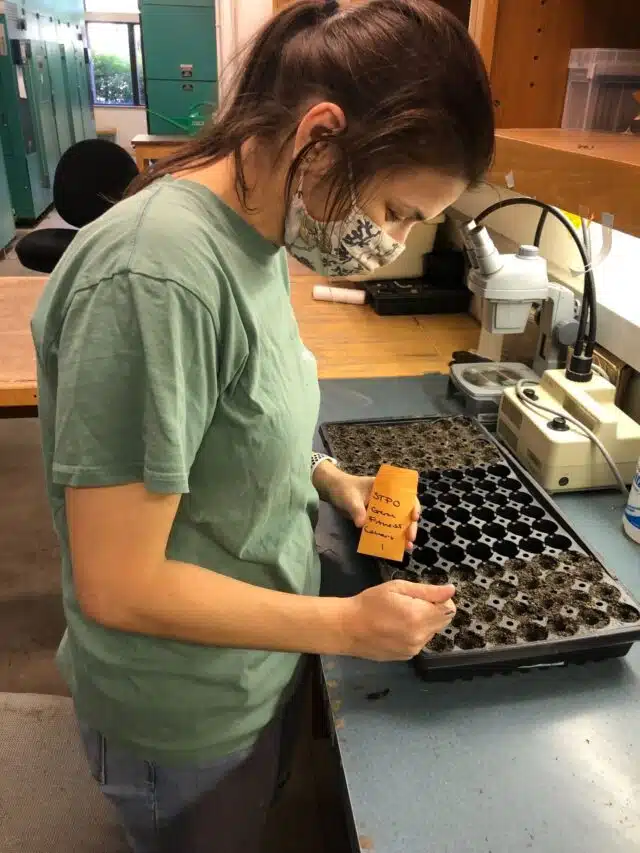
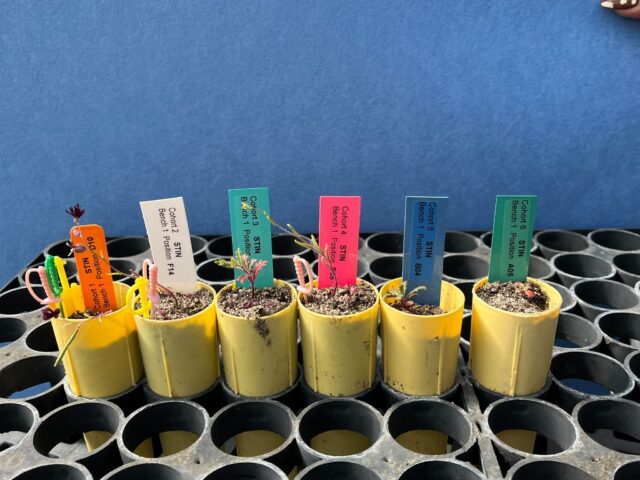
Not germinating is an obvious problem. But are there any drawbacks to germinating late? To find out, Worthy and her team first sprouted plants at different times by simulating ideal germination conditions. This allowed the team to follow plants that had germinated early, on time, or late to see how they’d fare later on. They monitored how big the plants got, how long it took the plants to form their first bud (and whether they flowered at all), and how many seeds they produced.
They found that in some species, late-germinating plants seem to attempt to compensate by flowering and setting seed faster, while they’re still smaller plants. Other species stuck to their new, delayed time-table. But it didn’t seem to matter — both groups saw losses to their seed production. No matter their strategy, as plants germinated later, they’d produce fewer seeds. Year after year, repeated losses like these can add up to have real conservation implications for those species.
Closer to Home
All over the world, different species have different seed germination requirements. Some are cued by temperature, some moisture, some even require trauma like wildfire or an animal’s digestive system. If plants stop getting their cues to germinate at the right times, those species will be at risk. So as the weather gets wackier as the climate changes, biologists are eager to learn as much as they can about which changes to weather might affect which species.
Worthy joined the HF&G research team last August. She’ll continue working with her collaborators in California while also starting new germination studies at the Arboretum. One new project, with the Holden Seed Bank, is already underway.
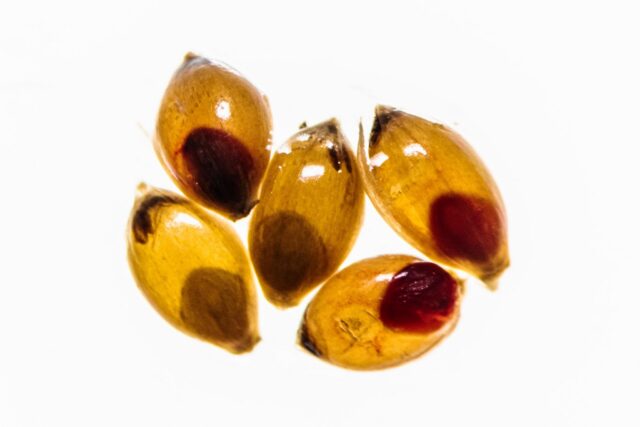
HF&G Seed Bank and Administrative Specialist, Valerie McCauley, has started testing the seeds in the seed bank’s collection for viability — whether they’re alive and able to germinate. To do this, McCauley uses a chemical solution called tetrazolium, a clear solution that turns red if it meets a viable seed embryo. Later, Worthy, McCauley, and seed bank manager Kim Lessman will begin germination trials to understand what conditions the local native species in the seed bank require for germination.
This work will provide the experts at Holden with better expectations for results from seed-based restoration as well as insights into how our native species are faring in natural areas generally. What will happen to our local native species as temperatures increase, or spring rains come at different times? Which species’ reproduction will be affected by climate change?
Down the road, Worthy and the seed bank team hope to share their findings with the Holden Arboretum Consulting Forestry team, who work directly with the woodland owners caring for Ohio’s forests. It’s a long way from an award-winning paper on California wildflowers to a woodland owner in Ohio stewarding their land — but that’s exactly the distance Worthy’s research is built to cross.
Anna Funk, PhD
Science Communications Specialist
Anna Funk is the Science Communication Specialist for Holden Forests & Gardens. She earned her Ph.D. studying prairie restoration before leaving the research world to help tell scientists’ stories. Today, she wears many hats, working as a writer, editor, journalist and more — anything that lets her share her appreciation of science and its impact with others.
Here’s more to explore

September 4, 2026
New Species of Diatom Discovered in Stebbins Gulch
Walking along a rocky creek at the bottom of a steep, shady canyon, ancient trees towering overhead, a surprising coolness on the breeze — a traveler might feel like they’re... more

August 21, 2026
In Northeast Ohio Urban Parks, Native Trees Do Just As Well As a Non-Native, New Study Shows
By Anna Funk, PhD, Science Communications Specialist
♫ Hot town, summer in the city. ♫ When it’s hot out, city centers are even hotter, thanks to all the concrete, asphalt, and machinery. This well-established heat island effect... more

July 30, 2026
Meet Carlo Moreno, Holden’s Newest Scientist
By Anna Funk, PhD, Science Communications Specialist
In Akron, Ohio, a community garden called Akron Cooperative Farms sits on land that was once used as baseball fields. Many of the gardeners there are immigrants and refugees from... more

June 3, 2026
New Study Tracks Long-Term Results of Forest Fungi Restoration Experiment
By Anna Funk, PhD, Science Communications Specialist
Few places are as intensively landscaped as golf courses. They’re mowed and manicured, they’re fertilized and kept chemically weed-free, and they’re tromped on half the year by golfers, carts, and... more

May 4, 2026
How Much Sun Is Too Much Sun?
By Anna Funk, PhD, Science Communications Specialist
Have you ever noticed a plant whose leaves were turning red or purple, especially in a particularly sunny spot? The plant may be making the red pigment you see to... more

January 6, 2026
Life in the Winter Forest
By Anna Funk, PhD, Science Communications Specialist
Take a stroll through the forest at the Holden Arboretum on a cold winter’s morning — the trails are open year-round — and the quiet stillness might trick you into... more

December 19, 2025
New Study Reveals How Beech Leaf Disease Disrupts the Forest Ecosystem
As beech leaf disease continues to sweep across our region, the longer-term effects of the disease are starting to reveal themselves in the epicenter — right here in Lake County.... more

December 5, 2025
What’s Happening Below the Forest Floor? Lessons Learned from Decades of Soil Data
By Sarah Kyker, PhD, Postdoctoral Research Associate
Caring for our planet includes an assurance that our natural ecosystems have a diversity of living things, clean water, thriving plants, and resiliency to disturbance. Soils are instrumental to all... more

November 11, 2025
What’s That Thing on the Emergent Tower? HF&G Tests New Forest Pest Monitoring Tool
By Anna Funk, PhD, Science Communications Specialist
If you’ve been to the Kalberer Emergent Tower at the Holden Arboretum lately — let’s be honest, who hasn’t (#fall) — you may have noticed something new: A pale purple... more