New Study Tracks Long-Term Results of Forest Fungi Restoration Experiment
June 3, 2026
Few places are as intensively landscaped as golf courses. They’re mowed and manicured, they’re fertilized and kept chemically weed-free, and they’re tromped on half the year by golfers, carts, and maintenance crews. So when a 100-year-old country club closes its doors and is slated to be restored to a natural area, it’s natural to wonder what state the soil is in and whether it can still support anything besides turf.
Researchers at Holden Forests & Gardens wondered, too. In 2016, after Cleveland Metroparks had started restoring the old Acacia Country Club, they invited researchers at HF&G and Jean Burns, plant ecologist at Case Western Reserve University, to collaborate on an experiment. The goal was to see how different species of trees, in different types of soil — with or without amendments containing beneficial soil fungi species — would fare.
Mycorrhizal fungi live in close partnership with tree roots and are essential for trees to get enough nutrients from the soil. In natural, mature forests, these fungi are abundant and diverse. The more intensely land is manipulated, the more these fungi can be put at risk. Can they be restored?
A new study, led by Claudia Bashian-Victoroff and published in Restoration Ecology, reports the long-term results of this experiment. Some of the inoculated species are still detectable in the soil — a win for the restoration of native fungi to the site. But when it came to supporting the trees, something else stole the show: sand that had been added to the teeing-off area of the old driving range.
Sanctuary in suburbia
The Lyndhurst, Ohio, Acacia Reservation is in an unlikely spot for a nature sanctuary. It’s in a high-traffic area full of commercial and residential spaces — Beachwood Place and Legacy Village shopping malls are both next door. But step inside the park boundary and the landscape opens up into trails, large trees, and what Bashian-Victoroff calls “a little sanctuary in suburbia.”
The site’s original Acacia Country Club, which opened in 1921, dissolved in 2008. It was purchased by a nonprofit fund and then donated to Metroparks in 2012, who began converting it back into natural habitat with trails, prairies, wetlands, and woods. One corner — the site of the old driving range — would become the research site.
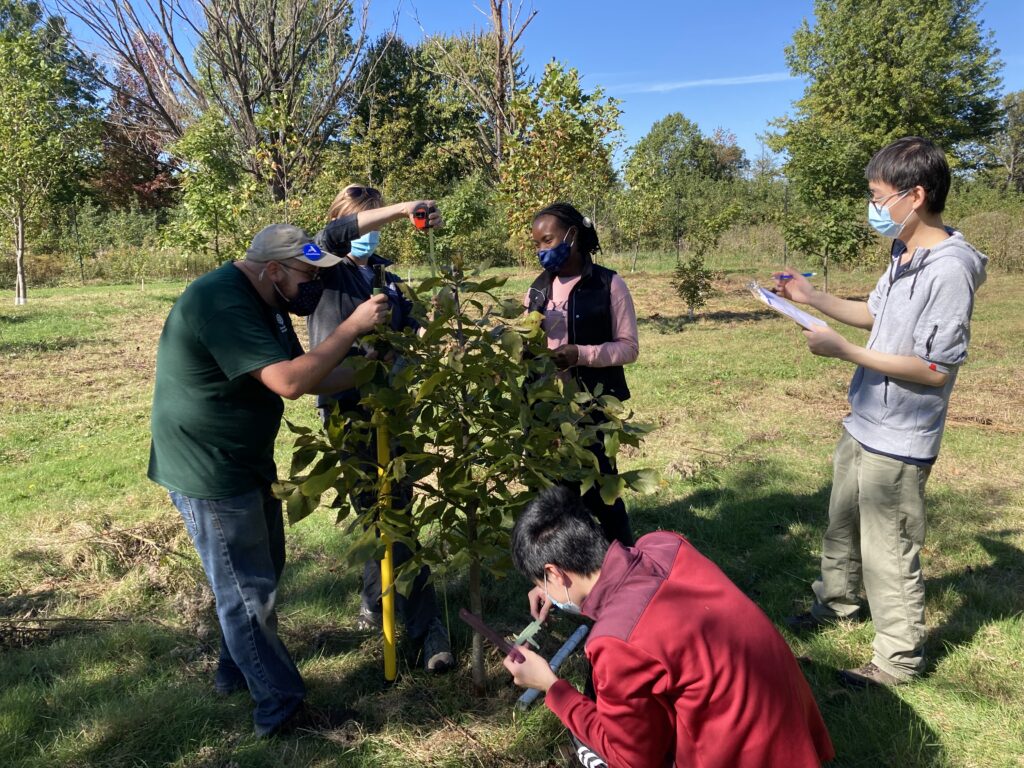
The experiment was initiated in 2016 by Andy Lance, then a PhD student at Case Western Reserve University working with Holden Arboretum and Cleveland Metroparks. (Today, Lance is the Arboretum’s Conservation Manager). The team planted 135 saplings — tulip trees (Liriodendron tulipifera), red oaks (Quercus rubra), and black cherries (Prunus serotina) — across 15 plots. Some received an addition of soil harvested from a nearby healthy forest, some received commercially available inoculum, and some were planted without any amendments as a control. Lance diligently watered the saplings over the first two years.
The team had to wait a few years to be able to see what the longer-term impacts might be on both the fungi and the trees they planted. When they returned to the site, they learned that the biggest factor influencing tree growth, tree survival, and the composition of soil fungal communities over the first few years wasn’t whether or which inoculum was used — it was how much sand or clay was in the soil.
Across the study site, two different soil types exist side by side. Much of the former driving range has clay loam soil, which is denser and slower-draining than sandier soils. But in the former teeing-off point, the golf course managers had added sand — enough that the soil composition is noticeably different today.
By 2021, trees growing in the sandier soils were outpacing those in clay soils in growth. And 21% of the trees in the clay areas died, while just 4% of trees in the sandy areas died. The differences in fungal communities between the two soil types were similarly stark.
Bashian-Victoroff said they remember thinking, “wow, this driving range, many, many years later, is still shaping fungi and impacting tree success.”
What about me? I’m a fun-gi
Although the sandy soils stole the show, the researchers still wanted to know what they could learn from the inoculation experiment. Early results had shown that inoculation did alter the composition of the soil fungal communities. Strangely, though, the commercial inoculant didn’t actually introduce the species listed on the label.
After five years, these effects had mostly faded, largely overtaken by the effects of soil texture. But for some trees (particularly, black cherries), forest soil inoculant that had been harvested from one particular location was especially successful. In those cases, the number of mycorrhizal fungal species that established was much higher, and some fungi were still detectable in 2023.
“We have inoculum that’s significantly increasing fungal species richness and diversity,” they said. “That’s very cool to me.”
Restoring the whole forest
So what does this mean for forest restoration practice? Bashian-Victoroff is cautious about recommending inoculation at a management scale just yet — particularly commercial products, which showed limited lasting effects and raise concerns about non-local fungi potentially displacing locally adapted species. Forest soil transfer is more promising in theory, but raises its own questions about how to do it sustainably without disturbing the healthy forests you’re drawing from.
Still, they’re hopeful. Effects on the trees in this study were limited, but restoring a forest from a golf course might be a rather extreme case when it comes to soil health — there’s a growing body of evidence that fungal inoculation does improve plant establishment and growth in all sorts of ecosystems, including forests. The trees at the Acacia Reservation might just be a normal deviation from the pattern that’s seen elsewhere, and finding out why could be extremely telling.
And although five years seems like a long time to wait to measure tree health, from a tree’s perspective, it really isn’t. Trees live for hundreds of years, and it’s possible that the changes to the fungal community from inoculation could benefit them down the road, for instance if there’s a drought or disease outbreak.
Importantly, the inoculation did reintroduce fungi to the site. Fungi are chronically understudied: Scientists estimate only around 175,000 of a possible 5 to 17 million fungal species have been described, and fungi are rarely considered in conservation or restoration efforts. So even in cases where immediate benefits to trees aren’t apparent, if inoculation works to reestablish species of fungi that have been lost from an area, that’s worthwhile in its own right. After all, a forest isn’t truly restored until all the species — fungi included — return, too.
—
Citation: Bashian-Victoroff, C. N., et al. (2026). Outcomes of commercial and forest soil inoculation on tree growth and mycorrhizal associations in a peri-urban forest restoration experiment. Restoration Ecology. https://doi.org/10.1111/rec.70344

Anna Funk, PhD
Science Communications Specialist
Anna Funk is the Science Communication Specialist for Holden Forests & Gardens. She earned her Ph.D. studying prairie restoration before leaving the research world to help tell scientists’ stories. Today, she wears many hats, working as a writer, editor, journalist and more — anything that lets her share her appreciation of science and its impact with others.
Here’s more to explore

September 21, 2026
We’re on PBS! Learn more about Holden’s people and places seen on “By Nature’s Design”
By Anna Funk, PhD, Science Communications Specialist
The experts and forests of Holden Forests & Gardens appeared on the PBS Western Reserve’s docuseries, “BY NATURE’S DESIGN,” which premiered this weekend. Season 2, “Inside the Forests,” showcases a... more

September 4, 2026
New Species of Diatom Discovered in Stebbins Gulch
Walking along a rocky creek at the bottom of a steep, shady canyon, ancient trees towering overhead, a surprising coolness on the breeze — a traveler might feel like they’re... more

July 30, 2026
Meet Carlo Moreno, Holden’s Newest Scientist
By Anna Funk, PhD, Science Communications Specialist
In Akron, Ohio, a community garden called Akron Cooperative Farms sits on land that was once used as baseball fields. Many of the gardeners there are immigrants and refugees from... more

July 20, 2026
Award-Winning Research Reveals How Wildflowers May Struggle Under Climate Change
By Anna Funk, PhD, Science Communications Specialist
In Ohio, we think of fall as the end of the growing season. But for many California wildflowers, fall is a beginning. From the deserts of Southern California to the... more

May 4, 2026
How Much Sun Is Too Much Sun?
By Anna Funk, PhD, Science Communications Specialist
Have you ever noticed a plant whose leaves were turning red or purple, especially in a particularly sunny spot? The plant may be making the red pigment you see to... more

April 20, 2026
Ways to Love a Forest: Stories of Woodland Stewardship in Northeast Ohio
By Anna Funk, PhD, Science Communications Specialist
A logger had been coming by Joe and Christel Diliberto’s Portage County home for years, offering his services. So when they wanted a few trees removed — and he said... more

January 6, 2026
Life in the Winter Forest
By Anna Funk, PhD, Science Communications Specialist
Take a stroll through the forest at the Holden Arboretum on a cold winter’s morning — the trails are open year-round — and the quiet stillness might trick you into... more

December 19, 2025
New Study Reveals How Beech Leaf Disease Disrupts the Forest Ecosystem
As beech leaf disease continues to sweep across our region, the longer-term effects of the disease are starting to reveal themselves in the epicenter — right here in Lake County.... more

December 5, 2025
What’s Happening Below the Forest Floor? Lessons Learned from Decades of Soil Data
By Sarah Kyker, PhD, Postdoctoral Research Associate
Caring for our planet includes an assurance that our natural ecosystems have a diversity of living things, clean water, thriving plants, and resiliency to disturbance. Soils are instrumental to all... more