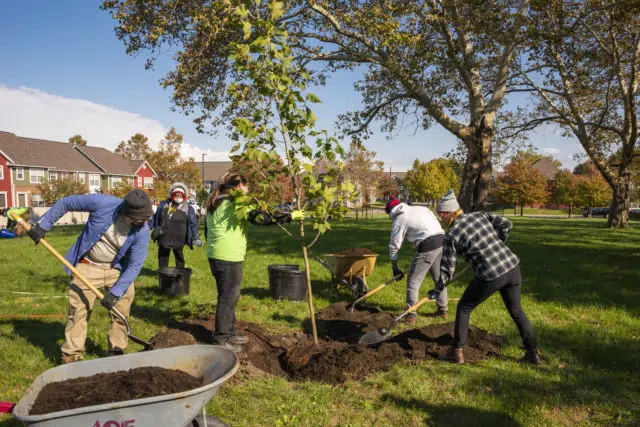
In Akron, Ohio, a community garden called Akron Cooperative Farms sits on land that was once used as baseball fields. Many of the gardeners there are immigrants and refugees from South Asia who come from traditional agricultural backgrounds, and they bring that expertise to the way they garden today. Their approach to weed control, pest management, and soil health draws on techniques from farming traditions thousands of miles away, which they’re adapting for Ohio’s climate and seasons. And that makes them exactly the type of people that HF&G’s new urban ecologist, Carlo Moreno, loves to learn from.
An entomologist — insect biologist — by training, Moreno works in biological systems where human involvement is front-and-center. Whether it’s the insects on the trees downtown, the pests in someone’s crops, or the soil organisms in a community garden, it’s all the same question to Moreno: how ecology and people shape each other.
Moreno’s new role at HF&G is unique, as research positions go. He’ll spend approximately half his time conducting research, and most of the rest working with the broader community to share research findings, develop educational materials, participate in community initiatives, and more.
“You need to have that engagement piece in order to make the research fit in with the needs of the community,” says Moreno. “Ultimately, if we need people to engage in ecological change, we need folks on the ground to be interested in doing it. For that to happen, there has to be involvement and cooperation between ecologists and the community.”
Born in a Broccoli Field
Moreno says he’s loved insects since he was a child. He always expected he’d grow up to study them. Growing up in the suburbs, he had his first encounter with agriculture as an undergrad, when he worked on a project in Salinas, California, “the salad bowl of the world.”
“It was the first time I’d ever been in a field,” he recalls. It was broccoli. “I just remember being so taken aback by how different everything was, and how complex running a farm was. I became really interested in this very strange thing that is food production.”
He didn’t pivot away from insects, of course. He just found a new system in which to study them.
“So I thought, here’s something I can do that involves insects and has a real-world benefit,” he says. “I continued to take on projects based in agricultural systems after that.”
Ever since, Moreno has moved around a lot, partnering closely with organizations and nonprofits to address ecological problems faced by different communities.
“It’s been really fun for me to go to different places, and at each place learn a whole new set of knowledge and skills from the people there,” he says. “Selfishly, I just really like learning from people who have their boots on the ground, who are doing this stuff all the time. I get so much out of hearing what they know.”
His Ph.D. work, in environmental studies at UC Santa Cruz, took him to Venezuela, where he studied native potato varieties with local farmers and the ecological benefits those varieties offered. From there, he moved to the U.S.-Mexico border for a post-doc at what’s now the University of Texas Rio Grande Valley, working with farmers navigating the transition to organic agriculture — and the barriers that come with it. Then came a faculty position at the University of Idaho’s extension program, where his focus shifted to large-scale growers, including barley farmers supplying Coors and other major brewers.
Moving to the City
He finally landed at the College of Wooster, a liberal arts college an hour south of the Arboretum. There, he was an associate professor of environmental studies, teaching undergraduates, conducting research, and last year, chairing his department. It was there his attention started to migrate from rural to more urban communities.
In addition to his work with Akron Cooperative Farms, he began to study brownfield renovation. Brownfields are sites that formerly housed an activity that has left behind some contamination, which makes repurposing the land challenging. Moreno worked with a grower who had started a lavender farm on the site of a former industrial plant, studying ways to improve the soil using healthy fungi, arbuscular mycorrhizae, and ways to control weeds using low-input methods.
Through all his work, Moreno has always focused on biological systems that directly impact — and are directly impacted by — humans. As HF&G’s new urban ecologist, he’ll bring that same focus to our urban environment.
“When I saw the job ad, I saw a really cool opportunity to work with the community, integrating my interest in urban ecology,” he says. “I really love the idea of combining research and education and outreach, so when I saw the job description, I thought, this is exactly what I want to do.”
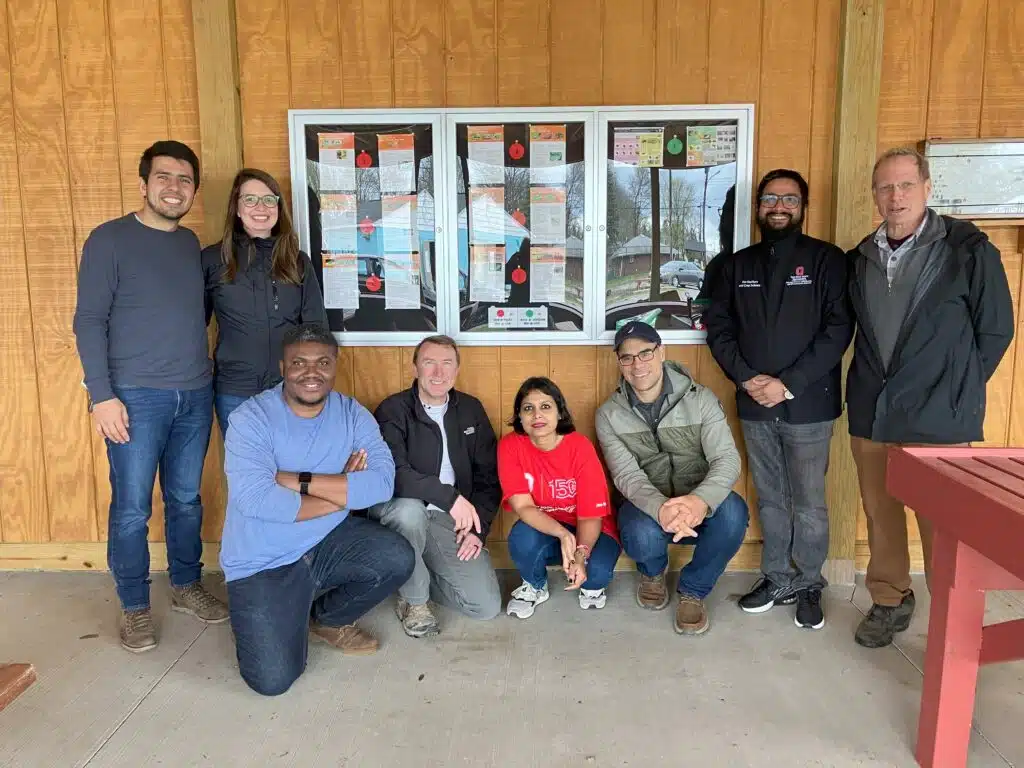
For now, Moreno is getting his bearings at the Long Center for Plant & Environmental Science and figuring out which projects and partners he’ll collaborate with first. “I have a lot of potential avenues to go down,” he says. “It’s a good problem to have.”
One of the first projects underway is at Lavender Trails in Medina, where Moreno is partnering with a local landowner to study ecological restoration on an abandoned pasture being transformed into a lavender agritourism enterprise. His team will study how pollinator communities differ among habitats and whether planting native host plants can increase pollinator use within restoration areas.
He’s also excited to continue collaborating with Akron Cooperative Farms. Together, they are developing an online guide to compositing with worms (called vermicomposting) to provide gardeners and urban farmers with practical, research-based resources for building healthy soils.
“I’m just so happy to be here. It’s been really good so far,” he says. “Everything’s been really great.”
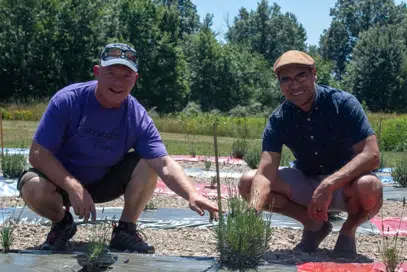
Cover image: Mallory Turnbull (Summer Intern) and Carlo Moreno visiting the restoration site in Medina on July 29, 2026.
Anna Funk, PhD
Science Communications Specialist
Anna Funk is the Science Communication Specialist for Holden Forests & Gardens. She earned her Ph.D. studying prairie restoration before leaving the research world to help tell scientists’ stories. Today, she wears many hats, working as a writer, editor, journalist and more — anything that lets her share her appreciation of science and its impact with others.
Here’s more to explore

September 4, 2026
New Species of Diatom Discovered in Stebbins Gulch
Walking along a rocky creek at the bottom of a steep, shady canyon, ancient trees towering overhead, a surprising coolness on the breeze — a traveler might feel like they’re... more

July 20, 2026
Award-Winning Research Reveals How Wildflowers May Struggle Under Climate Change
By Anna Funk, PhD, Science Communications Specialist
In Ohio, we think of fall as the end of the growing season. But for many California wildflowers, fall is a beginning. From the deserts of Southern California to the... more

June 3, 2026
New Study Tracks Long-Term Results of Forest Fungi Restoration Experiment
By Anna Funk, PhD, Science Communications Specialist
Few places are as intensively landscaped as golf courses. They’re mowed and manicured, they’re fertilized and kept chemically weed-free, and they’re tromped on half the year by golfers, carts, and... more

May 4, 2026
How Much Sun Is Too Much Sun?
By Anna Funk, PhD, Science Communications Specialist
Have you ever noticed a plant whose leaves were turning red or purple, especially in a particularly sunny spot? The plant may be making the red pigment you see to... more

February 11, 2026
Celebrating Women Scientists at Holden Forests & Gardens
By Anna Funk, PhD, Science Communications Specialist
On International Day of Women and Girls in Science, we’re taking a moment to appreciate the talented researchers advancing our understanding of forests, plants, and the ecosystems they support. From... more

January 6, 2026
Life in the Winter Forest
By Anna Funk, PhD, Science Communications Specialist
Take a stroll through the forest at the Holden Arboretum on a cold winter’s morning — the trails are open year-round — and the quiet stillness might trick you into... more

December 19, 2025
New Study Reveals How Beech Leaf Disease Disrupts the Forest Ecosystem
As beech leaf disease continues to sweep across our region, the longer-term effects of the disease are starting to reveal themselves in the epicenter — right here in Lake County.... more

November 11, 2025
What’s That Thing on the Emergent Tower? HF&G Tests New Forest Pest Monitoring Tool
By Anna Funk, PhD, Science Communications Specialist
If you’ve been to the Kalberer Emergent Tower at the Holden Arboretum lately — let’s be honest, who hasn’t (#fall) — you may have noticed something new: A pale purple... more

October 22, 2025
Newfound Garlic Mustard Aphid May Help, but Won’t Solve, Our Garlic Mustard Problem
By Anna Funk, PhD, Science Communications Specialist
In 2021, Rebecah Troutman — at the time Holden Arboretum’s natural areas biologist — was making her rounds and came across an insect she hadn’t seen before. It appeared to... more