Have you ever noticed a plant whose leaves were turning red or purple, especially in a particularly sunny spot? The plant may be making the red pigment you see to defend itself against the blaring light. New research from Holden Forests & Gardens gives insight into how this defense mechanism can work, and reveals that it’s not the only trick some plants can use to cope with the light.
The new study, published in the scientific journal AoB Plants, explores how Rhododendron minus (the Piedmont rhododendron) protects itself from light stress. It’s also the first publication led by Miranda Shetzer, a Ph.D. candidate whose research is based at HF&G under the guidance of plant physiologist Dr. Juliana Medeiros.
Too Much of a Good Thing
It’s no secret that plants need light to survive. But for some plants, too much of it can cause real problems for them. When a plant is exposed to more light than it can actually use for photosynthesis, the extra energy can damage its cells. It’s the plant version of a sunburn.
One of the ways a plant might defend itself against damage from the sun is by producing compounds called anthocyanins — the same pigments that color red fall leaves, purple cabbage, and blueberries.
“Just like we apply sunscreen to protect ourselves,” explains Shetzer. “Plants can use anthocyanins to help absorb some of that excess light and minimize the damage.”
R. minus is perfect for studying this phenomenon. It’s known to produce this anthocyanin sunscreen — rhododendron aficionados will be familiar with the reddish tinge its leaves can get when planted in too much sun. In the wild in the southeastern U.S., the plant grows across a wide range of light environments, from exposed, sun-blasted rock outcrops to shaded forest understories.
How is one plant able to grow under such different light conditions? To find out, Shetzer grew R. minus seedlings in the HF&G greenhouse under three light treatments — shade, standard greenhouse light, and intense supplemental light — and tracked how they responded over 12 weeks.
Avoiding the Sun
As expected, plants grown under the most intense light produced significantly more anthocyanin to protect themselves. But they also physically moved their leaves, drooping them downward so less surface area was exposed to direct light. If you’re familiar with how sunflowers track the sun as it moves across the sky, this is the opposite — they’re moving to avoid the sun.
Remarkably, despite growing under very different conditions, seedlings across all three light treatments ended up with similar total growth. That means the combination of pigment defense and physical adjustment appears to be enough to keep the plants on track, health-wise, even under stress.
Shetzer also compared plants grown from seeds collected at six different locations across the species’ range, from sunny mountain rock outcrops in North Carolina down to shady lowland forests in Alabama and Georgia. Even when grown side-by-side in identical conditions at HF&G, the plants with origins in colder, higher-elevation, northern sites consistently had the most anthocyanin in their leaves.
Since R. minus is evergreen, it’s the harsh winter sun at the mountain sites, where there’s no overstory shade for protection, that exposes the plants to intense light. The fact that those plants still produced the most anthocyanin, even when grown in the shade at HF&G, shows that plants of the same species, but from different locations, can have different traits that protect themselves from the stresses of their home environment.
This variation across the species, Medeiros explains, might prove extra useful for the species as the climate changes. “Variation is the secret to moving forward through chaos,” she says. “I think there is a rhododendron out there that is going to survive.”
A Homemade Tool for Collecting Plant Data
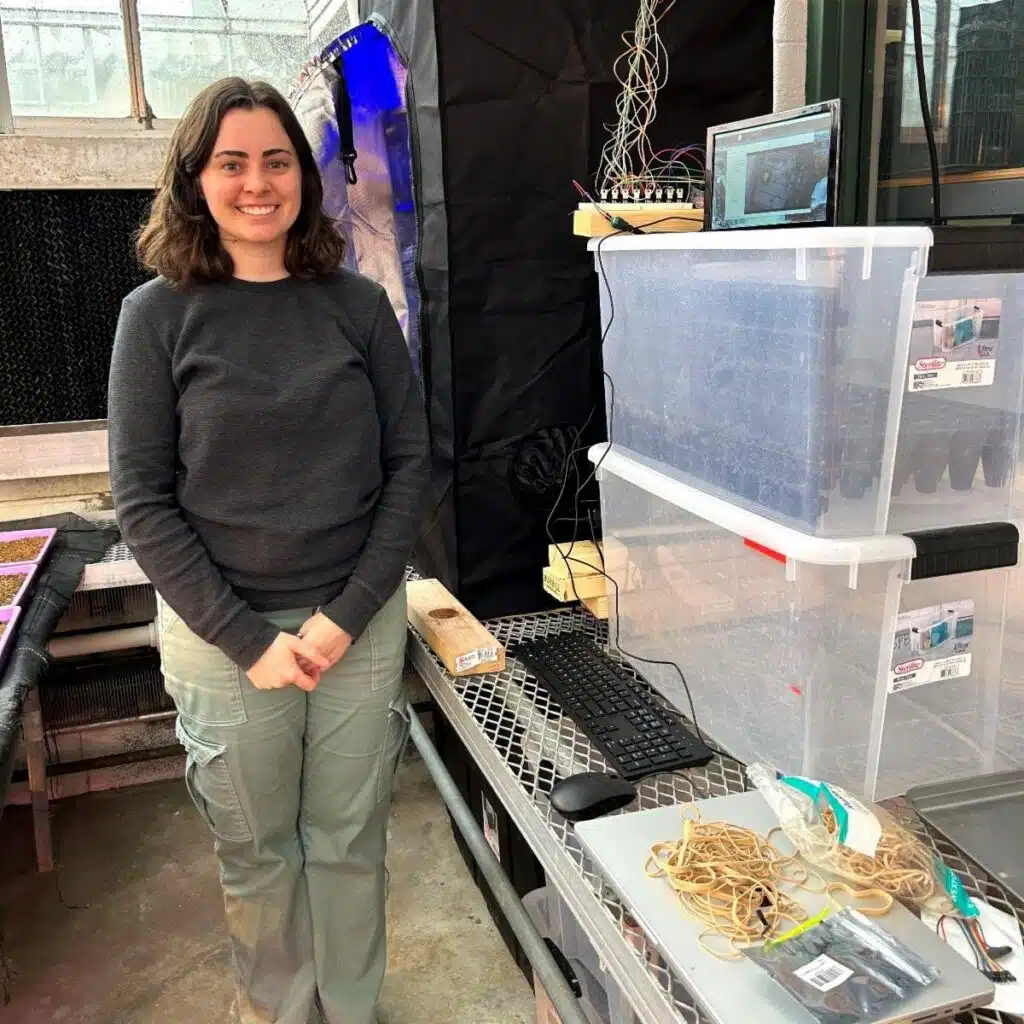
To compare anthocyanin levels across dozens of plants quickly, Shetzer built an imaging device developed by researchers at the University of Georgia. Most of the parts were ordered online: Her innovative setup includes colored LED strips (the same kind a person might use to light up their bedroom or car), a small camera, and a Raspberry Pi, a microcomputer about the size of a deck of cards. Together, they form a multispectral imaging system housed inside a tabletop lightproof tent in the Holden greenhouse.
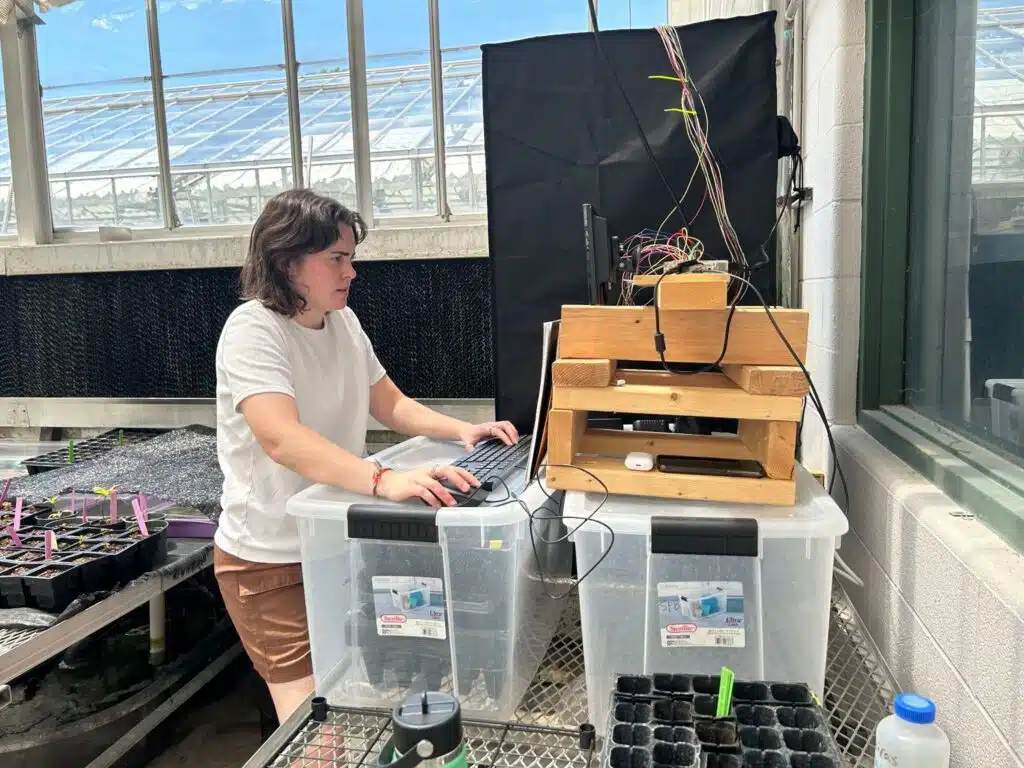
“This tool is one of the most compelling things about this work in terms of rhododendron research going forward,” says Medeiros. “If we want to understand variability, we need to study a lot of individuals — this method allows us to do that.”
The idea is simple: Different plant pigments absorb and reflect different wavelengths of light, in proportion to their concentration in the plant’s cells. So by shining red, green, or near-infrared light on a leaf, you can measure how much light is reflected back, which tells you how much light was absorbed and thus relatively how much anthocyanin or chlorophyll is present.
How do you capture data on light reflectance off a leaf? It’s called a photograph.
Traditional physiological measurements are time-consuming (imagine a thousand test tubes with leaf samples in a laboratory waiting to be chemically analyzed, one by one). This limits how many plants a single scientist can feasibly study. But a tool like this one will let researchers rapidly screen hundreds of individuals, which is critical for not only studying the diversity of R. minus across its range, but could have applications for all sorts of ecological research.
Collaborating for Success
The new research reflects the kind of collaborative work that’s a hallmark of Holden’s research program. Miranda Shetzer is one of a small cohort of graduate students conducting research through the BioScience Alliance, a partnership between Holden, Case Western Reserve University, and other local institutions. It allows students to earn their degrees through CWRU while being based at HF&G. She’s the third student to come through the program, which Holden co-funds with the other partners.
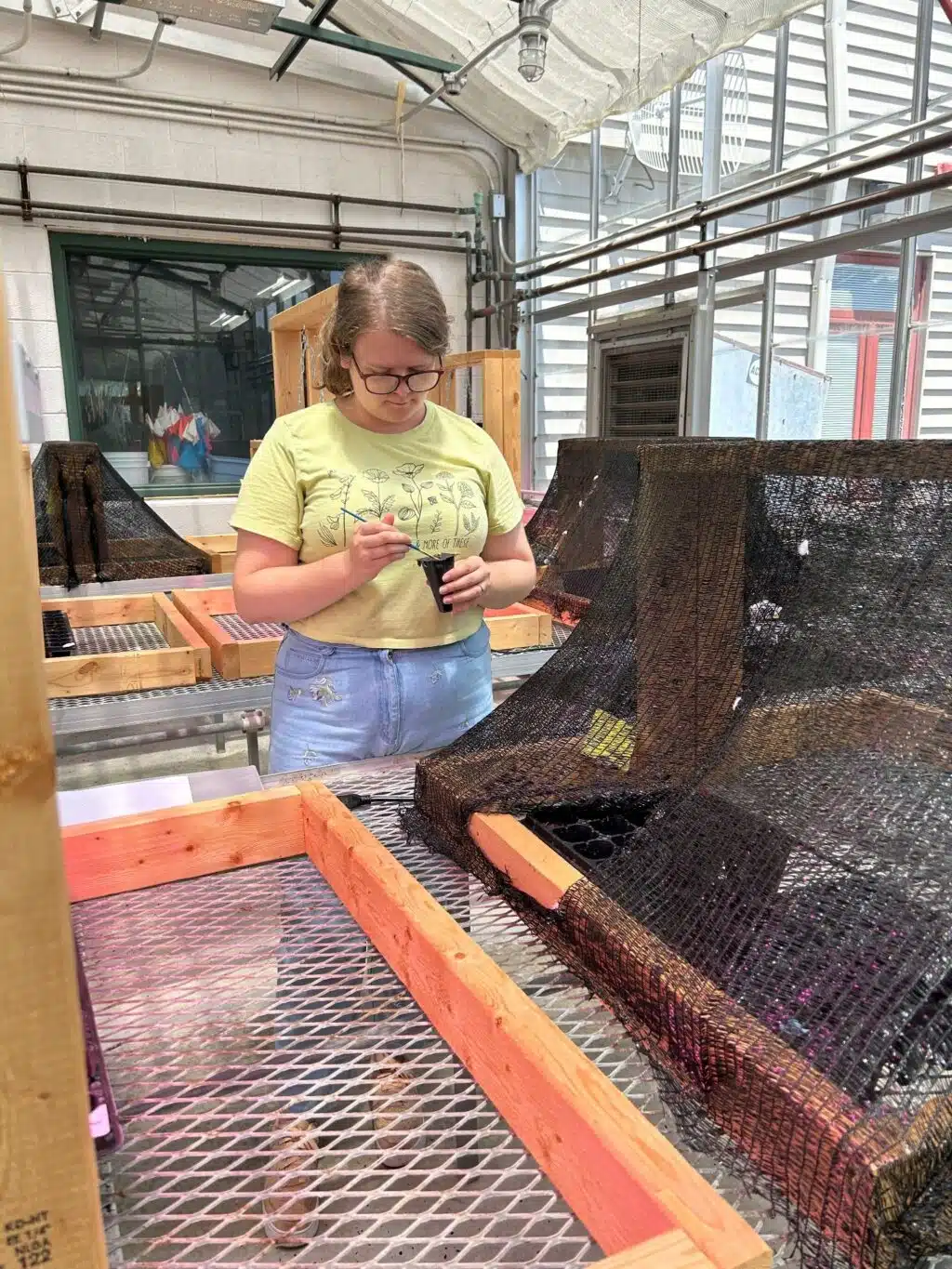
Under Shetzer’s guidance, Emma Farley, a Holden summer research intern, led the plant photography work central to tracking the leaves’ movement and co-authored the paper. High schooler Helena Duffy, a Holden Green Corps intern, collected pigment data from the plants from different locations. Farley has gone on to a scientific position in industry, Duffy is now at Dartmouth.
The study was also made possible by a fellowship from the Louise Harkness and David Sinton Ingalls Foundation. For most graduate students, research competes with other responsibilities like teaching undergraduate courses, grading assignments, and leading labs. A fellowship like this one changes that equation, making research the full-time job for a year. It’s a great blessing and an honor to be awarded something so valuable. “It’s allowed me to move much more quickly on my research,” Shetzer says.
This is the first chapter of Shetzer’s dissertation. She expects to graduate in spring 2027, with future work focused on how R. minus handles drought and whether its habitat range will shrink, shift, or hold as temperatures continue to rise.
Cover photo: Rhododendron minus growing on an exposed cliff at Hawksbill Mountain, North Carolina. (Credit: Stephen Krebs)
Citation: Shetzer, Miranda K., Emma Farley, and Juliana S. Medeiros. “Rhododendron minus seedlings achieve similar performance across light environments with anthocyanin accumulation and architectural adjustments under light stress.“AoB Plants 18.1 (2026).

Anna Funk, PhD
Science Communications Specialist
Anna Funk is the Science Communication Specialist for Holden Forests & Gardens. She earned her Ph.D. studying prairie restoration before leaving the research world to help tell scientists’ stories. Today, she wears many hats, working as a writer, editor, journalist and more — anything that lets her share her appreciation of science and its impact with others.
Here’s more to explore

September 4, 2026
New Species of Diatom Discovered in Stebbins Gulch
Walking along a rocky creek at the bottom of a steep, shady canyon, ancient trees towering overhead, a surprising coolness on the breeze — a traveler might feel like they’re... more

August 21, 2026
In Northeast Ohio Urban Parks, Native Trees Do Just As Well As a Non-Native, New Study Shows
By Anna Funk, PhD, Science Communications Specialist
♫ Hot town, summer in the city. ♫ When it’s hot out, city centers are even hotter, thanks to all the concrete, asphalt, and machinery. This well-established heat island effect... more

July 30, 2026
Meet Carlo Moreno, Holden’s Newest Scientist
By Anna Funk, PhD, Science Communications Specialist
In Akron, Ohio, a community garden called Akron Cooperative Farms sits on land that was once used as baseball fields. Many of the gardeners there are immigrants and refugees from... more

July 20, 2026
Award-Winning Research Reveals How Wildflowers May Struggle Under Climate Change
By Anna Funk, PhD, Science Communications Specialist
In Ohio, we think of fall as the end of the growing season. But for many California wildflowers, fall is a beginning. From the deserts of Southern California to the... more

June 3, 2026
New Study Tracks Long-Term Results of Forest Fungi Restoration Experiment
By Anna Funk, PhD, Science Communications Specialist
Few places are as intensively landscaped as golf courses. They’re mowed and manicured, they’re fertilized and kept chemically weed-free, and they’re tromped on half the year by golfers, carts, and... more

May 11, 2026
What Rhododendrons Know About Their Environment
By Anna Funk, PhD, Science Communications Specialist
As our world begins to warm, scientists are looking for early detection systems that will tell us what’s already being affected and help us predict what’s to come. Plants have... more

January 6, 2026
Life in the Winter Forest
By Anna Funk, PhD, Science Communications Specialist
Take a stroll through the forest at the Holden Arboretum on a cold winter’s morning — the trails are open year-round — and the quiet stillness might trick you into... more

December 19, 2025
New Study Reveals How Beech Leaf Disease Disrupts the Forest Ecosystem
As beech leaf disease continues to sweep across our region, the longer-term effects of the disease are starting to reveal themselves in the epicenter — right here in Lake County.... more

November 11, 2025
What’s That Thing on the Emergent Tower? HF&G Tests New Forest Pest Monitoring Tool
By Anna Funk, PhD, Science Communications Specialist
If you’ve been to the Kalberer Emergent Tower at the Holden Arboretum lately — let’s be honest, who hasn’t (#fall) — you may have noticed something new: A pale purple... more