As our world begins to warm, scientists are looking for early detection systems that will tell us what’s already being affected and help us predict what’s to come. Plants have been responding to environmental stressors for tens of millions of years, and those experiences are written into their physiology today. If you know how to read them, you can understand what they’re going through, and get a preview of what’s coming.
That’s part of what draws researchers at Holden Forests & Gardens to rhododendrons. With over 1,200 global species growing from tropical mountains to forests right here in northeast Ohio, the ancestors of today’s rhododendrons spent over 65 million years navigating environmental extremes. Today, the plants have proven to be useful scientific tools: Individual plants are sensitive enough to respond to their immediate environment, they’re widespread enough to make comparisons across climates, and they’re well-represented enough in HF&G’s collections that sometimes researchers just have to walk outside to collect new data.
Currently, a number of interconnected research projects are underway at HF&G in the Juliana Medeiros lab, all asking a different version of the same basic question: How do plants cope with stress, and what does that tell us about their future?
Coping with Color
When conditions outside are hostile — too cold, too bright, too hot — plants have to find ways to survive. One of their most visible strategies is to produce pigments to protect themselves.
Miranda Shetzer, a Ph.D. candidate at HF&G and Case Western Reserve University, is studying how Rhodedendron minus var. minus, a species native to the eastern U.S., adjusts its pigmentation under different light conditions. In greenhouse experiments, she found that seedlings exposed to different light conditions accumulate protective compounds called anthocyanins.
Read more: How Much Sun Is Too Much Sun?
“Under high light, seedlings often appear purple or red rather than green — not because the green chlorophyll disappears, but because you’re seeing the anthocyanins, which act as a protective ‘sunscreen,'” said Shetzer.
Shetzer’s work has also revealed that plants from warmer regions, where the plants typically grow in the shade, accumulate fewer anthocyanins than those from colder regions, where they’re in full sun. The pattern holds even when the plants from different locations are grown side-by-side under the same light at HF&G.
A Genus-Wide Picture
While Shetzer dives deep into a single species, researcher Dylann Nakaji-Conley is looking across many different Rhododendron species in the genus. In a new project, she’s leveraging HF&G’s extensive rhododendron collection to track how pigment concentrations change across the seasons in species from all over the world.
The new project will examine both anthocyanins as well as carotenoids, yellow-orange pigments that have a similar protective role. Earlier work by Medeiros showed that under cold stress, plants from warmer regions lean more heavily on carotenoids for protection, while those from colder regions rely more on anthocyanins. The new project aims to understand how this pattern plays out across different species.
By studying plants from different origins that are growing side by side, Nakaji-Conley will also be able to learn what’s inherent to each species due to their genetics. This distinction matters enormously for predicting how plants will respond to climate change.
The project is also investigating a potential link between leaf pigments and flower color. Rhododendrons show considerable variation in flower color both across and within species, and leaves and flowers share some of the same pigment-producing pathways. The researchers are curious to know if, for instance, a plant with purple flowers has more anthocyanins overall.
The Chemistry of Fragrance
While Nakaji-Conley makes headway on her pigmentation research, Catalina Valderrama, Norweb Fellow at HF&G, is asking how climate might impact a different category of compound that these plants are producing: scents.
Within the genus Rhododendron, 17 deciduous azalea species are native to North America, and some of them have a fragrance that can stop you mid-trail. But the chemicals responsible for that scent, called volatile organic compounds (VOCs), are doing way more than smell nice: They can influence pollination, deter pests, help cool the plant, and even affect the plant’s reproductive success. As temperatures rise, there’s a chance the function of these systems will be altered. If and how this will happen is an important question to answer.
VOCs have been studied in Asian rhododendron species, but the fragrant North American species remain largely uncharacterized. Valderrama is working under the supervision of Medeiros, who is leading the project, collaborators at the Gardner Lab at Case Western Reserve University, and collaborators around the world to build a catalog of what compounds are present, across which species, and under which conditions.
She’s using a common laboratory technique called mass spectrometry to analyze VOC samples from rhododendrons in HF&G’s collections during peak bloom, April through August, and comparing them to data from collaborators at gardens in Indonesia, New Zealand, and California. Data collection will wrap up at the end of the upcoming 2026 flowering season.
Watching Flowers Bloom
Finally, researchers are tracking how the timing of rhododendron flowering — called phenology — is changing over time. And you can help: HF&G is running a long-term volunteer monitoring program to collect the data. Volunteers are observing and recording bud formation, flowering, and fruiting across the collections, building a dataset that can eventually reveal climate-driven changes in these phenological patterns.
This program completed its first full season in 2025. The researchers estimate they’ll need about 10 years of observations to detect real phenological shifts, which means the data collected this coming summer (maybe by you?) will become a part of the scientific record that will help scientists in the future.
If you’re interested in participating this coming growing season, contact Sarah Hartley, Manager of Volunteer Resources (shartley@holdenfg.org) or Catalina Valderrama (cvalderrama@holdengf.org).
For more about rhododendrons at HF&G, visit holdenfg.org/rhododendron.

Anna Funk, PhD
Science Communications Specialist
Anna Funk is the Science Communication Specialist for Holden Forests & Gardens. She earned her Ph.D. studying prairie restoration before leaving the research world to help tell scientists’ stories. Today, she wears many hats, working as a writer, editor, journalist and more — anything that lets her share her appreciation of science and its impact with others.
Here’s more to explore

May 4, 2026
How Much Sun Is Too Much Sun?
By Anna Funk, PhD, Science Communications Specialist
Have you ever noticed a plant whose leaves were turning red or purple, especially in a particularly sunny spot? The plant may be making the red pigment you see to... more

May 9, 2024
It’s Poppin’: Leach Research Station
By Kara Grady, Conservation Horticulture Assistant, NOWCorps
It’s spring, which means that plants are popping at the David G. Leach Research Station! Home to Holden’s premiere rhododendron and azalea collection, our site near the shore of Lake... more

November 29, 2023
Rhododendron minus: A colorful mystery wrapped in a riddle
By Juliana S. Medeiros, PhD, Plant Biologist
Rhododendron minus is a woody evergreen shrub native to the southeastern United States, with a range that extends from North Carolina and Tennessee south into Georgia and Alabama. Across this... more

November 2, 2023
The Colors of Rhododendron’s Fall Foliage
Plant lovers are aware of the vibrant, showy flowers Rhododendron exhibit in spring. But did you know that some rhododendrons can display subtle yet colorful foliage that is worth taking... more

August 11, 2023
Fulbright Scholar Dr. Shweta Basnett to speak on Rhododendron pollinators
By Juliana S. Medeiros, PhD, Plant Biologist
Visiting Fulbright Scholar Dr. Shweta Basnett will hold lecture to highlight global diversity of Rhododendron pollinators and sensitivity to climate change. Dr. Shweta Basnett, Fulbright Scholar, University of Maryland, will... more
March 31, 2023
Mapping Plants at Northeast Ohio’s Rhododendron Paradise
By Phil Sturm, Data and Mapping Intern
Progress continues in our quest to map the plants here at the David G. Leach Research Station. For those new to this plan, we are using a very sensitive and... more

March 24, 2023
The Challenges of Rhododendron Research
Rhododendrons are loved by many gardeners for their bright, kaleidoscopic spring flowers. They are special for many reasons, including rhododendron being one of the most species-rich genus of woody flowering... more

January 6, 2023
From horticultural hero to cancer cure, what research has your Rhododendron done today?
By Juliana S. Medeiros, PhD, Plant Biologist
Your Rhododendrons are probably looking a little sad right now, amidst the cold wind and snows of January. They are probably drooping their leaves, maybe they have lost their beautiful... more
June 7, 2022
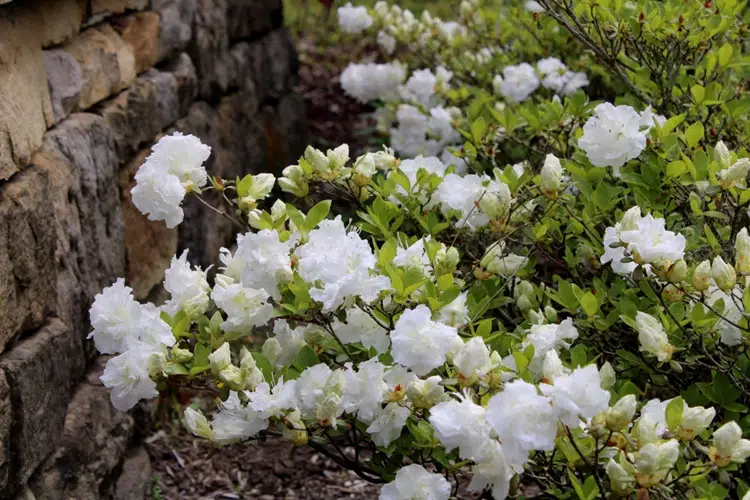
Rhododendrons in Bloom
By Sommer Tolan , Horticulturist
It’s interesting to observe the variation in rhododendron and azalea bloom times from year to year. Especially here in Ohio, where we’re not sure if snow or rain will be... more