Eastern Hemlock Research
at Holden Forests & Gardens
Researchers at Holden Forests & Gardens are working to save eastern hemlock trees from invasive pests through resistance breeding and innovative research.
The eastern hemlock (Tsuga canadensis) plays a vital role in our local forest ecosystems. But invasive forest pests and diseases, including hemlock woolly adelgid (Adelges tsugae) and elongate hemlock scale (Fiorinia externa), threaten these trees’ survival. In some areas, these tiny invaders have already killed nearly 80 percent of hemlocks.
Better Techniques for HWA-Resistance Breeding
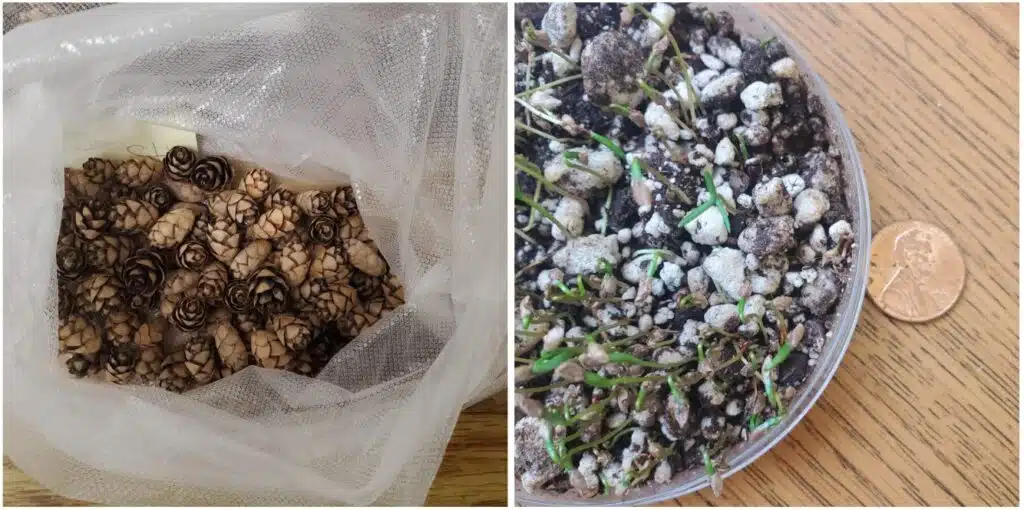
One major goal of the hemlock team at Holden is to develop better tools for studying and breeding resistant trees. They’re creating a new screening method to measure how well individual trees can fight off hemlock woolly adelgid (HWA), and crucially, whether that resistance comes from heritable genetic traits that can be passed down through breeding. The team is also experimenting with techniques to make trees flower and produce cones much earlier than normal — at just 2-5 years old instead of the typical 30 years. Speeding up this timeline will allow researchers to breed multiple generations much faster.
This work is in partnership with The Great Lakes Basin Forest Health Collaborative, U.S. Forest Service Northern Research Station, The Nature Conservancy’s Trees in Peril, and the New Jersey Forest Service, with additional funding from the Pennsylvania Department of Conservation and Natural Resources.
Breeding Resistant Hemlocks
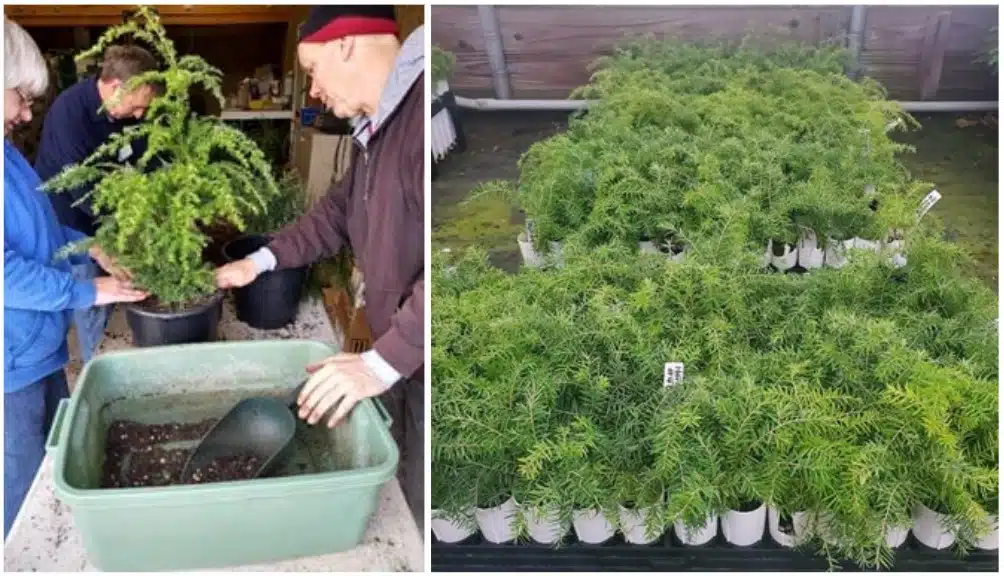
Holden Arboretum is putting these methods into action through an eastern hemlock resistance breeding program. The team and their collaborators have identified promising candidates from across the eastern United States: “lingering hemlocks” that survived the initial wave of HWA infestation and may carry genetic resistance. Researchers are creating clones of these trees through cuttings, testing their resistance using the new screening methods, and establishing them in greenhouse conditions designed to accelerate cone and pollen production. (In 2026, the team published a summary of best practices for propagating hemlocks.) This breeding population will become the foundation for developing the next generation of HWA-resistant hemlocks.
Effects of Pesticides on Hemlock Health
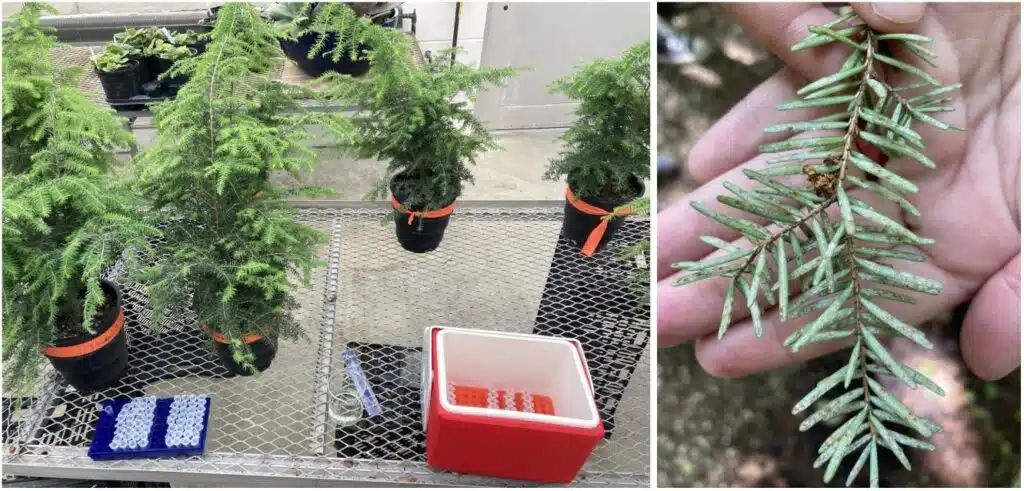
Pesticides can kill hemlock woolly adelgid — but what do they do to the trees themselves? Researchers in Holden’s soil ecology lab are investigating that question by applying Dinotefuran, a commonly used pesticide, to hemlock trees. Early results show that the treatment may come with tradeoffs: The bacteria living on hemlock leaves changed dramatically with pesticide application. These findings suggest that while pesticides can eliminate the pest, they might also weaken trees’ ability to grow and fight off other diseases by disrupting the microscopic organisms that help keep them healthy.
From the Get Growing Blog
For a deeper dive into our hemlock research, explore these recent blog posts from Holden scientists and science writers:
Know the Forest Pests That Live in Your Area: Holden Researchers Get the Word Out
by Anna Funk | Nov 20, 2025
Do you know what the symptoms of beech leaf disease look like? What about hemlock woolly adelgid — can you tell it from elongate hemlock scale, and did you know these are both insects that can harm trees? If your answers were “no, no, and no,” you’re not alone. Plenty of… Keep reading.
Protecting Eastern Hemlocks from Tiny Tree-Killing Invaders
by Albert Jackson | Jan 9, 2024
The Holden Conservation Department is on the hunt for tiny tree-killing pests. During the early and mid-20th centuries, two non-native tree dwelling insects were unintentionally introduced to the eastern United States through the sale of infected East Asian trees. Today, these two insects have spread through most eastern hemlock forests… Keep reading.
Monitoring Hemlock Woolly Adelgid Colonization
by Danny Dlugos | Mar 13, 2024
Eastern hemlock (Tsuga canadensis) is one of the most recognized trees in Northeast Ohio. Native to the eastern United States and Canada, it ranges from Nova Scotia south along the Appalachian Mountains to Alabama, and slightly westward throughout the Great Lakes region. In our area, it is often seen along… Keep reading.
Meet our Hemlock Experts


About the Long Center for Plant & Environmental Science
At the Holden Arboretum, the scientists at the Ellen Corning Long and T. Dixon Long Center for Plant and Environmental Science take pride in pioneering the science of plants and trees, conducting nationally recognized research while fostering the next generation of leaders in this space. Learn more about the Long Science Center ▶
About Holden Forests & Gardens
Holden Forests & Gardens is made up of two of Northeast Ohio’s most important environmental and cultural institutions — the Holden Arboretum and Cleveland Botanical Garden — and is the 12th largest public garden in the country. HF&G is a leader in plant science, advancing groundbreaking research and sharing discoveries that protect forests and natural areas. Learn more about Holden Forests & Gardens ▶
Keep in Touch
Stay up to date on our latest hemlock discoveries: Subscribe to The Lab & Field, Holden Forests & Gardens’ science and conservation newsletter.
Contact Holden Forests & Gardens
Media please contact:
Stacey Vaselaney
slvaselaney@slvpr.com
(216)905-0908
General inquiries:
Anna Funk
Science Communication Specialist
afunk@holdenfg.org